
Keno, with its lottery-esque charm, has captivated players worldwide, promising the thrill of big wins with relatively small stakes. As players chase those elusive winning numbers, many seek strategies to tip the odds ever so slightly in their favor. Among these approaches, the Top/Bottom split strategy stands out as a method for organizing number selection and structuring gameplay. This technique divides the Keno board into two halves, advocating for a balanced pick of numbers from each section.
The allure of the Top/Bottom split lies in its perceived simplicity and the sense of control it offers. By consciously selecting numbers from both halves of the board, some players believe they achieve a more balanced spread, potentially increasing their chances of hitting a winning combination. This strategy offers a way to bring structure to what otherwise might feel like a completely random game. Whether it’s just for fun or to try to organize the chaos of choices, many Keno enthusiasts feel like it improves their odds.
While the Top/Bottom split strategy might seem appealing, it’s crucial to understand its potential advantages and limitations. We will dive into a detailed examination of this strategy, exploring its potential benefits, drawbacks, and providing you with essential tips to make the most informed decisions when playing Keno.
Understanding Keno Basics
Keno, at its heart, is a game of chance where luck reigns supreme. To get started, understanding the fundamentals is key. The game revolves around a few core components: the Keno ticket, number selection, the draw itself, and the subsequent payout structure.
Imagine a board displaying numbers 1 through 80. This is the Keno board. Your gateway to the game is the Keno ticket. This is where you, as the player, mark your chosen numbers, often referred to as “spots.” The number of spots you can select usually varies, but it’s typically around 1 to 10 or 1 to 20, depending on the specific Keno game you’re playing.
Once you’ve made your selections, the real excitement begins. In a traditional Keno game, 20 numbers are randomly drawn from the 80 available. This draw can be conducted using a mechanical ball drawing system, or, more commonly these days, a random number generator to ensure fairness and unpredictability.
The more of your chosen numbers that match the numbers drawn, the more you win. The Keno payouts are determined by a payout table, which dictates how much you’ll receive based on the number of “catches” you achieve. The potential winnings are clearly posted, highlighting that Keno is fundamentally a game of chance, driven by the unpredictable nature of random number generation.
What are Top/Bottom Split Strategies?
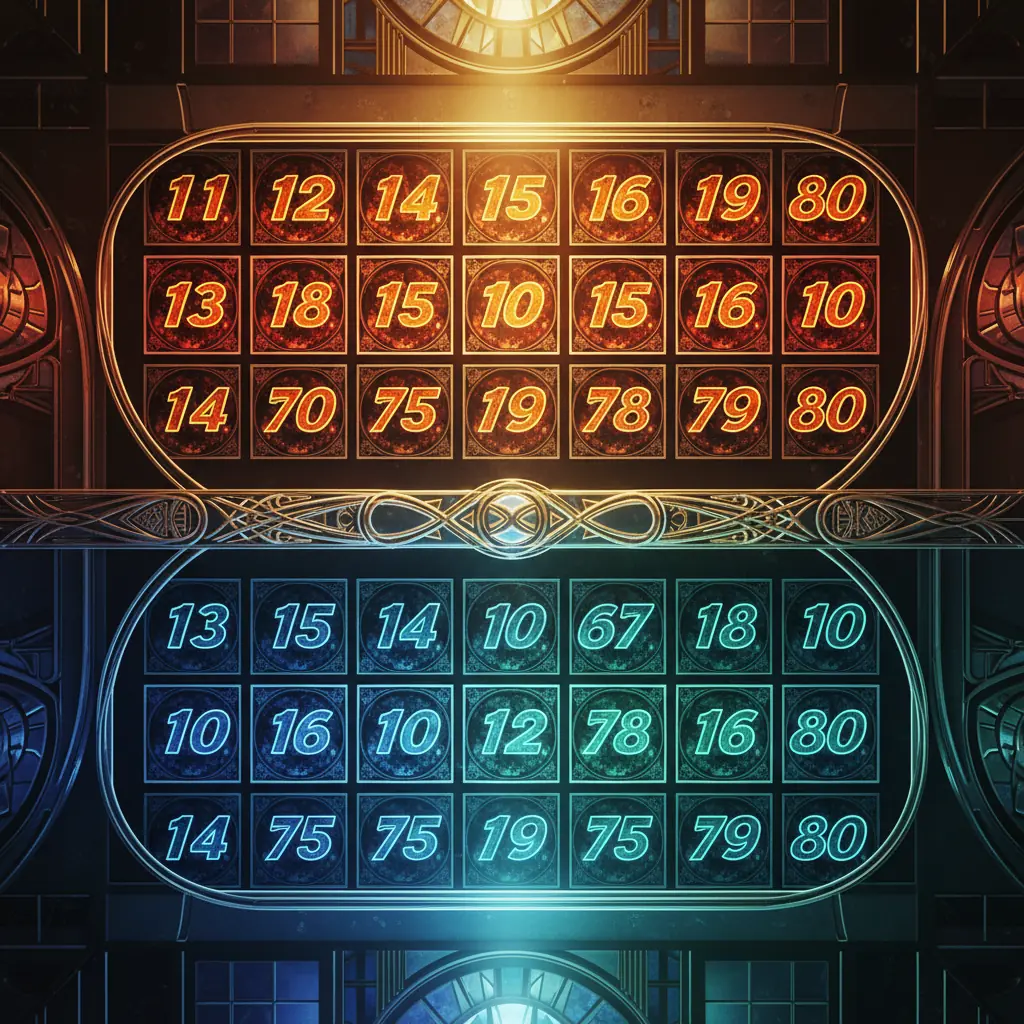
The Top/Bottom split strategy is a number selection technique used in Keno. It involves dividing the Keno board horizontally and focusing your picks predominantly on either the top or bottom half. Imagine the Keno board sliced in two; players using this strategy will choose most of their numbers from one of these halves.
For example, a player might decide that the top half of the board is “hot” and select eight out of their ten numbers from that section. The underlying idea is that Keno number draws might favor one half of the board over another in a given game or session.
Variations on the Split: Hybrid Approaches
The Top/Bottom split isn’t always a strict 50/50 division. Many players employ hybrid approaches. For instance, a 70/30 strategy means selecting 70% of your numbers from either the top or bottom, with the remaining 30% coming from the other half. An 80/20 split is used to emphasize one section heavily. The rationale behind these variations is to add a bit of spread, acknowledging that a completely one-sided draw is statistically less likely, and to potentially catch numbers that “stray” from the favored section.
Probability and Payouts
The “Top/Bottom split” strategy in Keno banks on the inherent randomness of the game, but it’s crucial to understand that using any strategy doesn’t actually change the underlying Keno probability. Each number, from 1 to 80, has an equal chance of being drawn in each game. The perception of increased success with this strategy often stems from a player’s focus on specific number ranges and the excitement of potential payouts.
The real key to understanding this strategy lies in carefully examining the Keno pay tables. Keno pay tables details the payouts for catching a specific number of picks. Understanding potential payouts is essential when employing the top/bottom split simply because the anticipation of hitting a significant win is much higher. Players need to analyze the pay tables to see what the payout will be if their strategy is a success.
Keno remains a game of chance. While employing strategies like the Top/Bottom split might make the game more engaging, it is important to be aware of the low odds and high house edge associated with Keno.
Understanding Pay Tables
Keno pay tables can vary significantly between different casinos, both online and in Las Vegas. Online Keno often has more diverse pay tables, with some offering higher payouts for hitting fewer numbers and lower returns. Pay tables in Las Vegas casinos can differ from each other. Always review the pay table before starting a game to adjust their number selection and betting strategy accordingly, and to be fully aware of the potential payouts.
Advantages and Disadvantages of the Top/Bottom Split Strategy
The Top/Bottom split strategy is favored by some Keno players due to the perception it creates of balanced number selection. This approach involves choosing numbers from both the upper and lower ranges of the Keno board, aiming to cover a broader spectrum. Players may feel this enhances their chances of hitting a winning combination by ‘hedging their bets’ across the number field. This perceived balance could lead to a more engaging and, for some, a more enjoyable playing experience.
However, the Top/Bottom split strategy has significant disadvantages. A primary drawback is the false pretense that this method improves the odds in a game of pure chance. Keno draws are entirely random; past results or number placement have no influence on future outcomes. The split strategy offers no statistical advantage over selecting numbers purely at random or based on personal preference. It’s essential to recognize that Keno, like most lottery-style games, has a substantial house edge. The Top/Bottom split strategy cannot overcome this inherent disadvantage. Players should approach Keno with a clear understanding of these limitations, recognizing that any perceived benefit of the split strategy is psychological rather than mathematical.
Implementing the Top/Bottom Split Strategy
How Many Numbers to Pick
The number of spots, or numbers, a player chooses significantly impacts the odds and potential payouts for both the Top/Bottom split strategy and other Keno variations. Choosing just 1 spot, while seemingly simple, carries a low probability of success. On the other hand, selecting 10 spots presents a greater challenge, as matching all ten becomes statistically less likely. A balanced approach, often around the 4-7 spot range, can provide a reasonable blend of hit frequency and potential reward. This range allows for strategic number selection within the Top/Bottom split framework, maximizing the potential for a fun and, hopefully, rewarding experience.
To effectively use the Top/Bottom split strategy, one must consider various factors. Firstly, identify whether the “top” or “bottom” half of the Keno board (numbers 1-40 or 41-80) seems more active based on recent draws. Then, select a group of numbers primarily from that half. Percentages aren’t as important as the overall concentration. For example, if focusing on the “top,” choose 4-5 numbers from 1-40 and perhaps 1-2 “covering” numbers from 41-80. This approach isn’t about rigid rules, but about tilting the odds slightly in your favor based on observed patterns.
Effective bankroll management is crucial, no matter the strategy. If starting with a $50 bankroll, consider setting a limit of $1-$2 per game. Never chase losses; if the chosen numbers aren’t hitting, resist the urge to increase the bet size in an attempt to recoup losses quickly. Keno is about entertainment, and responsible gambling ensures it remains that way. Setting reasonable betting limits prevents overspending and keeps the experience enjoyable, win or lose. Remember, the goal is to have fun and potentially win, not to treat Keno as a primary source of income.

Alternative Keno Strategies
Beyond the core strategies, players often explore alternative Keno strategies to spice things up and potentially improve their odds. These approaches often involve a blend of observational analysis, statistical guesswork, and a touch of personal intuition. However, it’s crucial to remember that Keno is fundamentally a game of chance, and no strategy can guarantee a win.
One popular alternative involves analyzing “Hot and Cold” numbers. Proponents believe that certain numbers are “hot,” appearing more frequently in recent draws, while others are “cold,” appearing less often. Players might choose to focus on hot numbers, cold numbers, or even a combination of both! Another tactic is called the “Edge Numbers” strategy.
Some players prefer using random number selection, either through a computer-generated system or simply by picking numbers that come to mind. Other players swear by a kind of “balanced strategy” that attempts to cover a wide range of numbers across the Keno board. While these alternative Keno strategies can add an element of fun and engagement to the game, they should be approached with a clear understanding of the game’s inherent randomness.
Expert Tips and Tricks
Want to boost your keno game? Let’s dive into some expert tips and tricks that can shift the odds a little more in your favor. While keno is fundamentally a game of chance, smart play can make a difference.
One often-overlooked tactic is to analyze past results. While each draw is independent, spotting number patterns that appear frequently can inform your choices. Another key is bankroll management. Decide on a budget before you start and stick to it. Chasing losses is a surefire way to deplete your funds quickly. Consider varying your number selections. Sticking to the same numbers repeatedly might feel lucky, but spreading your picks increases your coverage across the board.
Exploring keno variants can also be beneficial. Some versions offer bonus payouts or different betting structures that might align better with your risk tolerance and playing style. Keno boost strategies sometimes involve focusing on a smaller set of numbers and increasing the wager amount. Remember, responsible gaming is paramount. Keno should be fun. When it stops being enjoyable, it’s time to take a break.
Conclusion
In summary, the Top/Bottom split strategy in Keno offers a structured approach to number selection, dividing the Keno board into upper and lower sections. While it provides a framework for choosing numbers, it is essential to remember that Keno remains a game of chance. No strategy can guarantee winnings, and the Top/Bottom split is no exception.
This method can be a way to diversify number choices, but it should not be mistaken for a foolproof system. Responsible gaming is paramount. Keno should be enjoyed as a form of entertainment, with players fully aware of the odds involved. The Top/Bottom split is simply a tool to organize gameplay, and understand limitations.
As an expert in the field, I advise approaching Keno with a balanced perspective. Strategies like the Top/Bottom split can add a layer of interest, but the core element of chance should never be overlooked. For further insights and alternative approaches, explore available resources. Enjoy the game responsibly!